How These 'Tiny' Artists Triggered Spotify Algorithm 17X In A Row
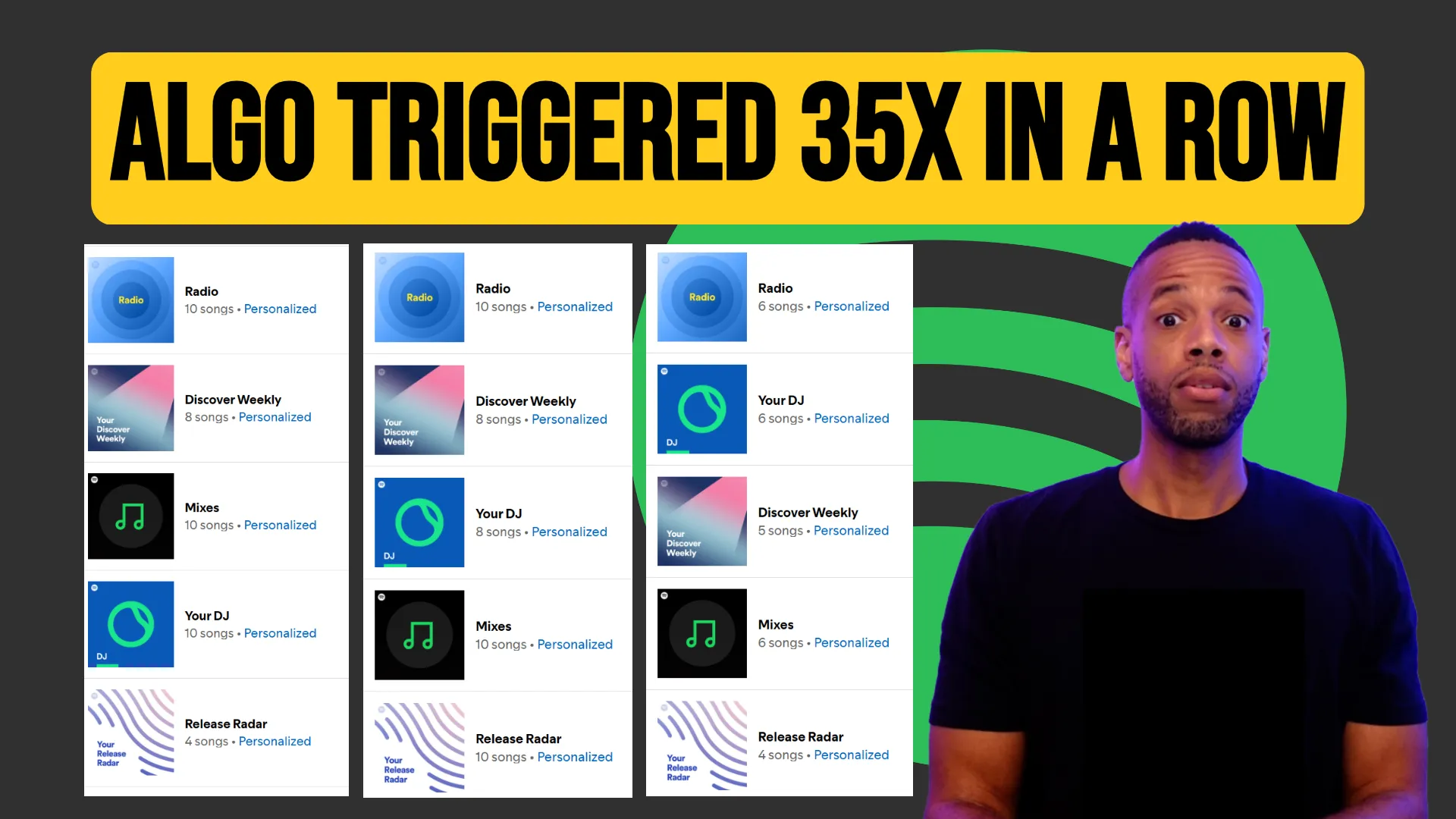
Three emerging artists with under 1,000 Spotify followers have managed to trigger Spotify's algorithm 17 consecutive times. Not 17 times across their entire careers, but 17 times in a row.
Here's how the 17 consecutive algorithm triggers broke down:
Honey & The Velvet Revival: 10 songs triggered the algorithm
Elara James: 6 songs achieved algorithmic placement
Imani May: 1 song completed the streak
Total: 17 consecutive algorithm triggers
To understand how remarkable this is, consider that most artists celebrate when a single song gets picked up by Spotify's algorithmic playlists like Release Radar or Discover Weekly. These three artists didn't just get lucky once, they developed a systematic approach that consistently delivers results.


Understanding Spotify's Algorithm: What Really Triggers Success
Spotify's algorithm doesn't care about your follower count, your marketing budget, or your industry connections. It cares about specific listener behaviors that indicate genuine engagement:
Save-to-Listener Ratio
This measures how many people save a song to their library compared to how many people listen to it. The optimal range is 2% to 10%, with higher percentages being significantly better.
When someone saves a song to their library and plays it from their user profile, they're sending the strongest possible signal to Spotify that this music has genuine staying power. This behavioral data tells the algorithm that the song deserves wider exposure.
Key insight: Algorithm playlists naturally have lower save ratios than songs promoted through social media ads. Spotify's algorithm accounts for this difference and adjusts expectations accordingly.

Completion Rate: The Skip Test
If listeners consistently skip your song before it finishes, Spotify interprets this as a negative quality signal. Once you're on genuine playlists, there's no gaming this metric. Either people genuinely enjoy your song enough to listen through, or they don't.
Songs in the 17-song streak consistently showed completion rates above industry averages, indicating genuine listener satisfaction rather than artificial engagement.
Stream Velocity in the First 48-72 Hours
The algorithm pays special attention to how quickly a song gains momentum (this can be right at release or even later down the line for your existing songs). Songs that generate consistent streams within their first few days signal to Spotify that they're worth testing on broader audiences.
The Secret Weapon: How Playlist IQ Eliminated Budget Waste
Most playlist pitching services operate on a "pay-to-reject" model. Artists pay upfront fees, often $2-6 per playlist submission, only to receive rejection after rejection. With typical acceptance rates of 10-30%, artists end up spending hundreds of dollars with minimal results.
If you spend $1,000 on traditional playlist pitching and 90% gets wasted on rejections, you only get $100 worth of actual playlist placements. With fewer playlist placements, you generate less algorithmic momentum, creating a cycle where budget constraints limit your algorithm potential.
Playlist IQ revolutionized this process through its unique "respond first, pay later" model that all three artists utilized:
Key Advantages That Enabled the 17-Song Streak:

1. Risk-Free Pitching
Curators give initial interest responses for FREE, and artists only pay for feedback when curators express genuine interest in adding the song. This eliminates wasted budget on rejections, a common problem with platforms that charge upfront fees.
To be clear, artists are paying for feedback. However, the curator gives a response during the free review indicating whether or not they think the song would fit their playlist.
So if a curator pays for feedback & the playlist owner does not add their song, they would be going against their word they gave during the initial review and their Trust Score on the platform would go down.
The Trust Score is visible to all artists prior to submitting to any list and helps keep everyone honest on the platform.
This way, artists are not paying directly for playlist additions, but also not wasting 70-90% of their budget on rejection notes.
2. Quality Control Through Trust Scores
Each curator on Playlist IQ has a trust score based on their track record of staying consistent in their word to artists (i.e. adding songs when they say they would, not moving songs to unfavorable positions, not removing songs early from the list, etc.) This helps artists avoid curators who simply want to expose artists.
3. Advanced Filtering Options
Artists can filter potential playlists by:
- Genre and mood compatibility
- Estimated streaming ranges
- Follower growth rates
- Geographic targeting
- Price ranges
- Historical performance data
4. Pre-Release Submissions
Unlike many services, Playlist IQ allows submissions up to two weeks before a song goes live on Spotify. This enables artists to:
- Accumulate curator responses before release day
- Line up multiple playlist placements for immediate impact
- Build momentum that hits right when the song becomes available
5. Global Reach Without Geographic Bias
Contrary to industry myths, Spotify's algorithm doesn't prioritize US-based streams over international ones. What matters is the engagement metrics, regardless of geographic location. Playlist IQ's global network of curators helps artists tap into this worldwide potential.

The Strategic Monday Release: Timing for Maximum Impact
1. Reduced Competition
While most artists release on Fridays, Monday releases face significantly less competition for playlist curator attention and algorithmic testing slots.
2. Building Weekend Momentum
Songs released on Monday have five days to build streams and engagement before the weekend, when music consumption typically peaks. By Saturday and Sunday, these songs can already be gaining algorithmic traction.
3. Discover Weekly Positioning
Spotify updates Discover Weekly playlists every Monday. Songs that show strong engagement throughout the week are more likely to be included in the following Monday's Discover Weekly updates, often providing a secondary boost exactly one week after release.
4. Extended Promotion Window
A Monday release allows for a full week of focused promotion before the next wave of Friday releases creates noise in the marketplace.
Complete Release Strategy Checklist (2 Weeks Before)

2 Weeks Before:
- Finalize song and upload to distributor
- Create Playlist IQ account and set up pre-release campaign
- Research and filter relevant playlists using platform tools
Monday or Tuesday (Release Day):
- Confirm song is live across all platforms
- Activate approved Playlist IQ placements
Friday-Next Monday (Release Week):
- Monitor for algorithmic playlist additions (Typically Radio playlists and Release Radar will hit first. This can happen the first or second week)
- Assess initial save-to-listener and streams-per-listener ratios
Post-Release Optimization Week 2
- Analyze Discover Weekly inclusion (Monday update)
- Double down on promotion if engagement ratios exceed targets (If you already know a song is working why not get as many plays per day as possible? This way you can get residual income long term as Spotify will likely include this song in more people's algorithm playlists when you boost it)
- Consider additional playlist campaigns if performance is strong
- Document learnings for future releases
Conclusion: Replicating Success Through Strategic Execution
Honey & The Velvet Revival, Elara James, and Imani May proved that algorithmic success isn't about having the biggest budget, it's about spending efficiently. By avoiding the 70-90% budget waste of traditional playlist pitching and using playlists found on Playlist IQ's strategic approach, they maximized their playlist placements and algorithmic impact.
Instead of getting 1-3 playlist placements from a $1,000 budget (with 90% wasted on rejections), these artists secured more quality playlist placements. More placements meant stronger algorithmic signals, which led to consistent algorithm triggers across all 17 songs.
Their success demonstrates that independent artists can compete with major label resources not by spending more, but by spending smarter. Understanding how Spotify's algorithm works and executing a budget-efficient playlist strategy creates sustainable algorithmic success.
The future of music promotion belongs to artists who understand both the data and the economics. For independent artists willing to invest in strategic playlist campaigns that maximize budget efficiency, the opportunity to trigger Spotify's algorithm consistently has never been greater.
These AI Music Tools Will Change Your Career!
Create any music you can imagine, then promote it like the majors all-in-one platform. 1 person = an entire record label with these tools.
Recent Posts


Smarter Music Marketing. Smarter Music Creation.
START HERE
LEGAL